

Bristol-based Kelpi is a world-leading sustainable materials innovation business, developing seaweed-derived alternatives to plastic packaging which are recyclable, biodegradable and marine-safe.
Awards won by the company include Barclays Entrepreneur of the Year 2024, Global Good Start Up Enterprise of the Year, and a record-breaking six Tech South West Awards in 2023.
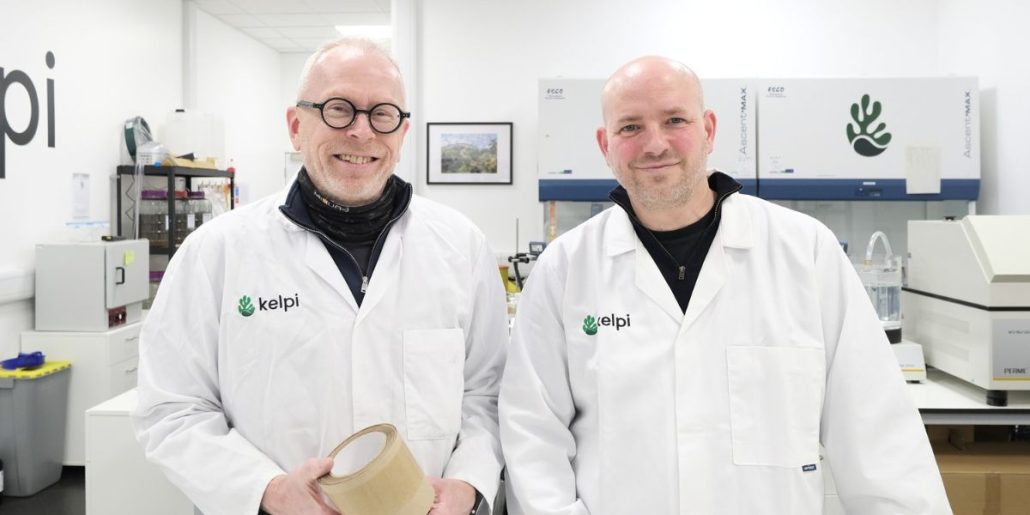
A leadership shakeup was recently announced at the company, with founder Neil Morris becoming non-executive chair and CCO Hugo Adams stepping into Neil’s shoes as CEO.
We sat down with Neil and Hugo to learn more about the team’s ambitions at this crucial juncture, the journey so far, and what’s on the horizon for this fast-growing South West biotech firm.
Let’s kick off with an easy one: what does Kelpi do?
Neil: We develop materials for the next generation of sustainable packaging.
Hugo: Working with global brands and multi-national businesses, we provide alternatives to single-use plastic packaging. That includes replacing multi-layer plastic packaging in global haircare and skincare products, developing barrier solutions for sustainable alcohol bottles, replacing PET in card/fibre trays for high juice content fresh cut fruit and other good stuff.
Neil – you founded Kelpi in 2020, and the company has been on quite a journey since then. What have been your proudest achievements and key milestones along the way?
Neil: It would be easy to rate our successful funding rounds as key milestones, as we raised over £7m in three rounds between 2021 and 2024. But that’s not what this is all about.
The key milestones have really been about winning, and retaining, clients. Persuading some of the largest food & drink and personal care companies in the world to work with Kelpi not only made for some of the most important milestones, but was the ultimate validation of what the company is all about: material innovation as a service.
Hugo – What do you see as the most significant opportunities and challenges in the sustainable packaging industry over the next 3-5 years, and how do you plan to position the company to address them?
Hugo: You’ve given me the answer in your question. Because right now sustainable packaging is not an industry.
Kelpi and other innovators are bringing entirely new, innovative thinking into what has traditionally been a thin-margin, mass production manufacturing industry. So the biggest opportunity is to take this to the mainstream, and to show large manufacturers as well as global food and personal care companies that they don’t have to choose between biodegradability and packaging performance. They can have both.
One of the biggest challenges we’ll face in the next 3-5 years is on costs, and getting our material down in price to get closer and closer to what packaging companies are used to paying for plastic.
Neil – What aspects of the company’s future development are you most excited to observe and support from a strategic oversight perspective?
Neil: Kelpi did not set out to develop and optimise a single material solution.
From the outset we were about building a platform and becoming a bio-material innovation company developing and exploiting our own IP, applying our technology to different feedstocks. Already we’re using AI to identify new opportunities, pointing us to where we can focus our world-leading lab teams to develop new material composites and laminates.
This will enable us to move faster towards a range of solutions on our platform, all designed to avoid any of the microplastic or PFAS problems of fossil fuel plastic packaging.
Hugo – Which core elements of the company’s culture and values do you consider essential to preserve, and which areas do you believe need evolution as the company grows?
Hugo: What Neil has built here is a combination of world-leading scientific talent with deep business expertise and experience. Having those two things in balance, with neither dominating the other, is one of the things that attracted me to join the business in 2023 and I’m determined to build on this.
Over the coming months we’ll be announcing a series of new hires to grow the team into key areas. Those new roles will help us continue to evolve the company’s culture as we shift from an R&D base to one more focused on meeting the operational demands of working for some of the world’s largest food and personal care companies as they transition away from fossil fuel plastic packaging.
Neil – what one lesson would you give to founders starting out in the tech world today?
Neil: Kelpi is my sixth startup, though not all have been tech-focused. What I’ve learned through each of them is to do something that matters.
This is going to occupy most, if not all, your waking moments. It has to matter. Founding a startup is not something to do to make money. If that’s what you want to do then work for, and succeed at, large companies.
Do it because it matters to your customers, users or clients. Because you’ve identified something that they really want or need.
Don’t fall into the trap of building a product and then trying to sell it. Make sure you remain close to what matters to your clients.
Do it because it matters to the world. Your startup should be focused on something that makes the world a better place.
That doesn’t mean we all need to work on climate tech – having fun, enjoying music, communicating with friends and family are all important. But make it matter.
Hugo – where does Kelpi go next?
Hugo: We are still awaiting regulatory approval for packaging food and drink. Once we achieve that in the next year, we’ll be ready to scale up rapidly to become a global materials innovation company.
Remaining relevant on a global scale has never been so challenging, with rapid changes to world markets happening at a bewildering speed, led by the nature and pace of change in the US right now. But the drive for more sustainable solutions will not be stopped by a single US president.
The human and planetary health problems created by plastic are only getting worse, and becoming more apparent as each year goes by.
So my answer is simple: we have to go global because that’s where the problems are.
Share this article
NEWSLETTER
Sign up for our newsletter to keep up to date with the latest news, events and updates from the South West tech sector.